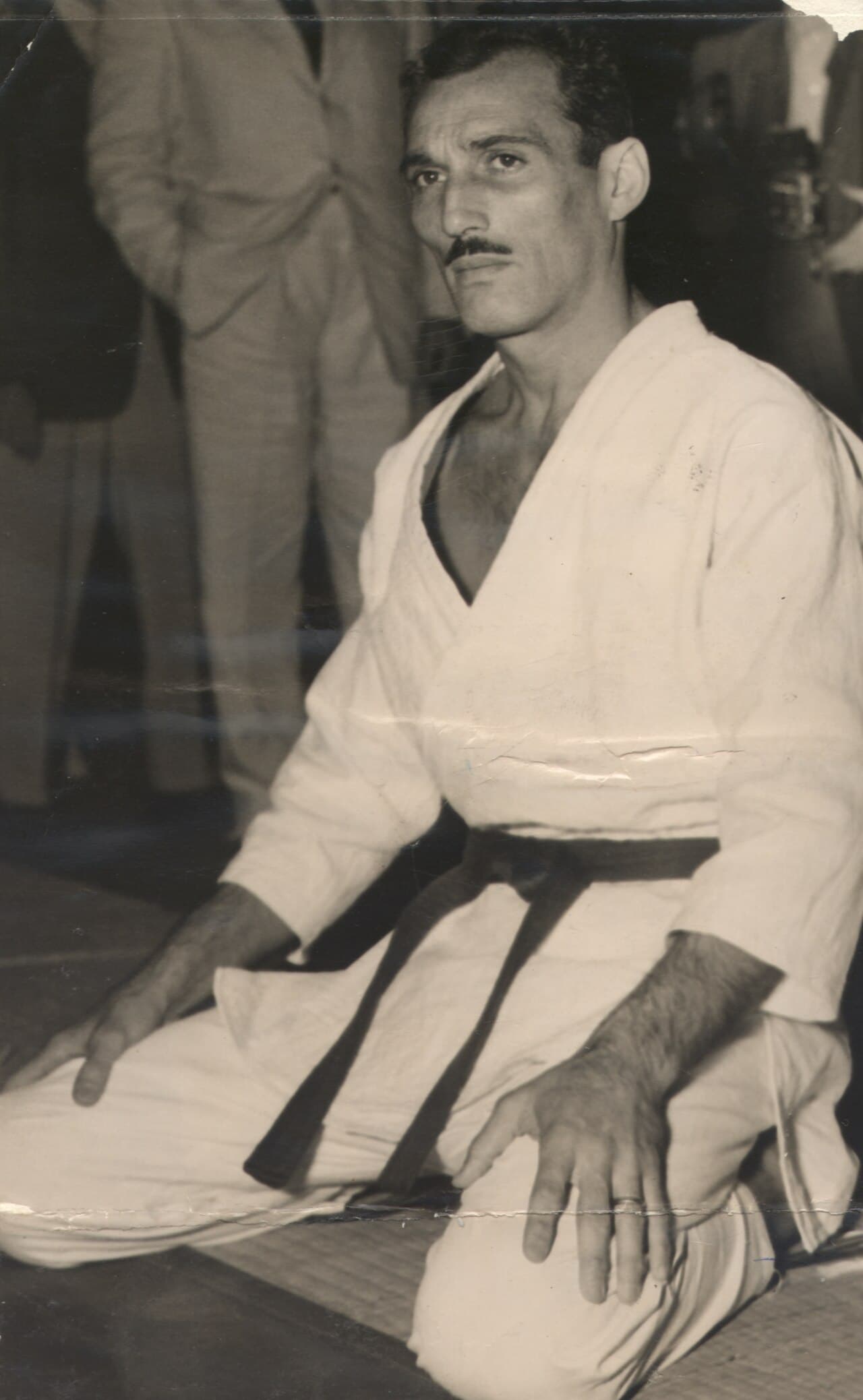
1913-2009
Helio Gracie
He fought in public for three decades under rules that barely existed, and the losses in that record did more to shape what the family taught than the wins did.
Helio Gracie was born on 1 October 1913, the seventh of Gastao Gracie's nine children, and the family's account of his childhood is consistent on one point: he was too frail to be allowed to train. BJJ Heroes describes him watching his older brothers spar in the academy Carlos opened in Rio rather than taking part, and only being admitted to normal classes once Carlos discovered he had been practising in secret and was already competent. He was eighteen when Carlos put him in his first vale tudo match, against a boxer named Antonio Portugal, in 1932.
The technical claim usually attached to him follows from that biography: that being small and weak forced him to rebuild what he had been taught around leverage and timing rather than strength, and that this is the moment Japanese jiu-jitsu became Brazilian. It is a good story and it may well be true in outline, but no source consulted for this entry documents a specific technique he changed, or a before-and-after that could be inspected. Pedreira treats the leverage narrative as a retrospective marketing frame rather than a recorded sequence of technical decisions. What can be documented is the record itself, and the record is a mixed one.
The best-known match is against Masahiko Kimura in Rio on 23 October 1951, and the accounts of it disagree in almost every particular. BJJ Heroes has Helio drawing with and then choking the smaller Japanese fighter Yukio Kato before Kimura would accept the fight, and has Kimura finishing Helio early in the second ten-minute round with a reverse ude-garami, the lock the sport now names after Kimura. The biography of Kimura hosted by Judo Info gives a substantially different version: it calls the first opponent Kado, has him choked unconscious by Helio, puts twenty thousand spectators and the president and vice president of Brazil at the Kimura fight, and has Helio's elbow broken and his corner throwing in the towel. The same site notes an interview in which Helio himself said Kimura had choked him unconscious. Three accounts, three finishes.
BJJ Heroes also does something useful with the two claims most often attached to that fight: that Kimura offered to concede if Helio lasted three minutes, and that he outweighed Helio by thirty-six kilograms. It reports finding no record of the first being said, and argues from the two men's other recorded weights that the real difference was likelier to be around ten kilograms. Neither correction diminishes what happened. Both change what the fight is evidence of.
The other landmark is the 1955 match against Waldemar Santana, a former student, which BJJ Heroes describes as the longest recorded no-holds-barred fight at three hours and forty-two minutes and which Helio lost by knockout. He was forty-one. It was his last fight of consequence, and after it he taught: his own sons, Carlos's sons, and, through them, most of the people who carried the method out of Brazil.
The last part of his contribution is institutional and is easy to miss. When jiu-jitsu in Rio acquired a federation in 1967, Helio was its president, with Carlson Gracie as director of the technical cabinet and Oswaldo Fadda as his deputy. The rules of that first body were crude by modern standards - GracieMag records five-minute matches with three minutes of overtime, and a single point for a takedown or the mount - but they are the ancestor of every points table the sport has argued about since. Helio spent the rest of a long life arguing that competition rules were corrupting the thing they scored. He died on 29 January 2009, aged 95.
What changed because of them
He was the family's public fighter from 1932 to 1955, in an era with no sanctioning body and almost no rules, and he was then the principal teacher of the generation that exported the method. He also presided over the first Rio federation in 1967, the direct ancestor of modern competition rule sets, while publicly opposing what those rule sets did to the art.
Where the record is contested
- Accounts of the 23 October 1951 fight against Masahiko Kimura differ on the finish, the crowd, and the name and fate of the earlier Japanese opponent. BJJ Heroes has Helio submitted by reverse ude-garami in the second round; the Judo Info biography has his elbow broken and his corner conceding, and notes an interview in which Helio said he had been choked unconscious. This entry states no single version.
- BJJ Heroes reports that it could find no record of Kimura's often-quoted offer to concede if Helio lasted three minutes, and argues that the frequently repeated 36kg weight difference was more likely around 10kg. Neither fighter was weighed.
- The claim that Helio rebuilt Japanese technique around leverage because of his size is universal in the family literature and is not documented as a specific technical change by any source consulted here. Pedreira treats it as a marketing narrative.
- The date of the first Rio de Janeiro federation is given as 1967 by both BJJ Heroes and GracieMag, but BJJ Heroes elsewhere gives 1969 for the same body. The earlier date has two sources behind it and is used here.
- The photograph is catalogued by the Arquivo Nacional as Helio Gracie and dated 1952; the photographer is recorded as unknown. The English description on the file page reads "Young Helio Gracie", which sits oddly with a subject who would have been 38 or 39 in that year.
Sources
- Helio Gracie, fighter profile, biography and fight recordBJJ Heroes · consulted 2026-08-04
- Jim Chen and Theodore Chen, "Masahiko Kimura Bio: The Man Who Defeated Helio Gracie"Judo Info · consulted 2026-08-04
- Masahiko Kimura, "My Judo" (translated excerpt)Judo Info · consulted 2026-08-04
- Oswaldo Fadda, master profile (source for the 1967 federation and the 1955 Helio quotation)GracieMag · consulted 2026-08-04
- File:Hélio Gracie (1952).tif, image licence and provenanceWikimedia Commons / Arquivo Nacional (Brazil) · consulted 2026-08-04
Elsewhere in Guard Theory
Journal
- The kimura as a control before it is a finish
The figure-four grip on a wrist is worth more for the arm it removes from the exchange than for the submissions it occasionally produces.