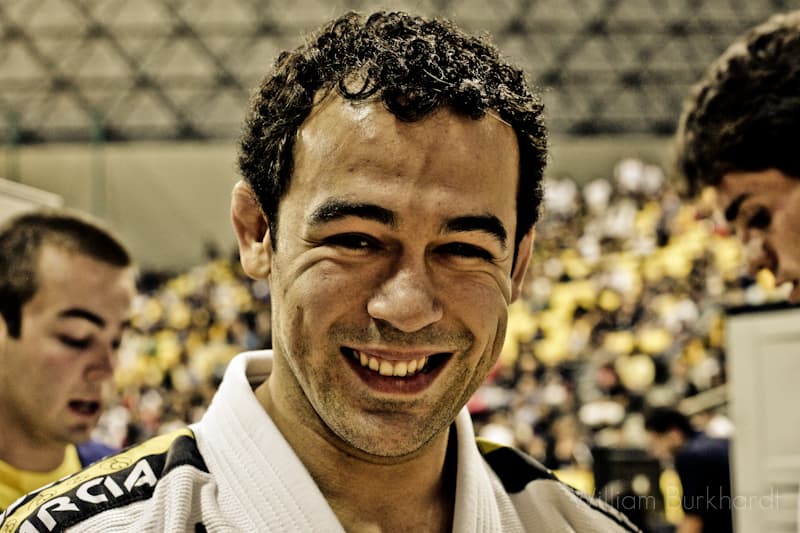
born 1983
Marcelo Garcia
He won at the top of no-gi grappling with a deliberately small set of positions, and then taught that set in public, which changed what a competitive game is expected to look like.
Marcelo Garcia was born on 17 January 1983 in Formiga, a small town in Minas Gerais with no jiu-jitsu in it. BJJ Heroes traces the sequence backwards from there: four years of karate from the age of eight, judo under Fabiano de Souza, then trips of some distance to train jiu-jitsu under Iran Brasileiro, then a move at sixteen to Paulo Rezende's academy in Pocos de Caldas, sleeping at the gym and cleaning the mats in exchange for training. He arrived at Alliance in Sao Paulo as a four-stripe brown belt and had never trained without the gi.
His first appearance at ADCC, in 2003, is the part of the story that is hard to improve on. He lost the Brazilian trials final by a single point and did not qualify; he got in as a last-minute replacement when another competitor withdrew; and he then won the event, beating Renzo Gracie and Vitor Ribeiro on the way. BJJ Heroes lists three further ADCC titles, in 2005, 2007 and 2011, and IBJJF world titles in 2004, 2006, 2009, 2010 and 2011. The International Brazilian Jiu-Jitsu Federation lists him in its Hall of Fame.
What is distinctive is the shape of the game rather than the count of the medals. The techniques he is associated with are few and they interlock: the arm drag as an entry, butterfly guard and X-guard as the platform, the back as the destination, and the rear naked choke, guillotine and north-south choke as the finishes. His recorded results skew heavily towards submissions rather than points. That combination - a narrow system, applied against opponents who knew exactly what was coming - is the argument for depth over breadth, made in public against the best available resistance, and it is why the way competitors talk about building a game changed after him.
The second half of the contribution is pedagogical. He moved to New York in 2009, opened an academy, and gradually stepped away from a brief mixed martial arts career to teach. BJJ Heroes records his first two black belts, awarded in December 2011, going to Josh Waitzkin and Alexander Meadows. A competitor whose system is legible enough to be taught to adult beginners in another country, in another language, is doing something different from a competitor who simply wins.
It is worth stating what this entry does not claim. It does not say he invented the arm drag, the butterfly guard, the X-guard or the north-south choke, because none of the sources consulted support that and all four predate him. What the record supports is narrower and more interesting: that he assembled a small number of existing positions into a system coherent enough to win four ADCC titles and five world titles with it, and open enough to be copied. Most of the systems taught in no-gi rooms today are structured the way his was, whether or not the people teaching them know where the structure came from.
What changed because of them
Four ADCC titles and five IBJJF world titles won with a deliberately narrow, interlocking system built on the arm drag, butterfly guard and back attacks, taught openly rather than kept as a competitive secret. The modern habit of describing one's grappling as a connected system rather than a collection of techniques is traceable to that example.
Where the record is contested
- The competition results here are taken from BJJ Heroes, which lists them by year without linking to bracket records. No accessible official ADCC results archive was reachable on the date of writing; the ADCC site returned no response and its rules pages were behind a challenge page. The IBJJF Hall of Fame listing is official and confirms his standing, not the individual years.
- The claim that his system changed how competitors structure their games is an interpretation of the record, not a sourced statement by anybody quoted here.
- No technique in his game is claimed as his invention. The arm drag, butterfly guard, X-guard and north-south choke all predate him and none of the sources consulted attribute them to him.
Sources
- Marcelo Garcia, fighter profile, biography and grappling recordBJJ Heroes · consulted 2026-08-04
- Hall of Fame (Marcelo Garcia Vespucio listed among male inductees)International Brazilian Jiu-Jitsu Federation · consulted 2026-08-04
- File:Marcelo garcia.jpg, image licence and provenanceWikimedia Commons · consulted 2026-08-04
Elsewhere in Guard Theory
Technique Library
- Seat belt and hooks
Back control is held by the chest connection first and the legs second, and understanding that ordering explains most of what goes wrong when the back is lost.
- The arm drag
Pulling an opponent's arm across their own centreline removes the limb that was defending one side of their body, which is why the same motion works standing, seated and from the guard.
- The butterfly hook as a lever
A butterfly hook only produces a sweep when it is loaded with the opponent's weight first, which is why the position rewards connection and posture rather than a fast kick of the leg.
Journal
- Taking the back from turtle
Three scoring tables define back control in three different ways, and what they disagree about tells you more than what they share.
- The guillotine from the front headlock
Arm in or arm out changes what the technique is, and the finish comes from the hips in both cases, which is why pulling harder with the arms is the standard way to lose it.
- The rear naked strangle from back control
A strangle and a neck crank are separated by a small change in what the second hand is doing, which is why four rule books bothered to write the difference down.