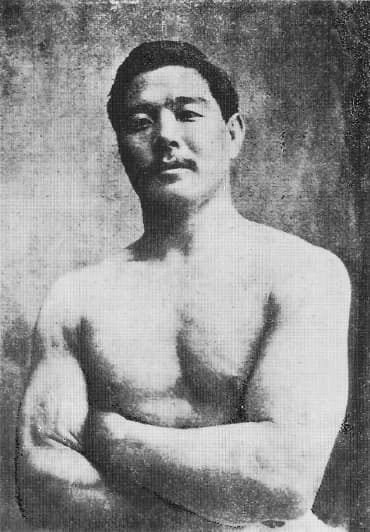
1878-1941
Mitsuyo Maeda
The Kodokan judoka whose club in Belem is the point where every Brazilian jiu-jitsu lineage claims to begin, and the point at which the documentation stops agreeing with itself.
The short list of things the sources do not fight about is genuinely short. Japan's National Diet Library, writing as part of its project on a century of Japanese emigration to Brazil, places Maeda's birth in 1878 in Funazawa village, in Aomori Prefecture, and has him enrolling at the Kodokan the year after he first met judo, reaching third dan in 1901 and becoming one of the institution's leading young men. He left for the United States in 1907 with Tsunejiro Tomita, worked his way through Europe and Latin America, arrived at the port of Santos in 1914, and settled in Belem, at the mouth of the Amazon, in 1915. He died there in November 1941, at 63.
What he was doing for those thirty-odd years is less flattering to the origin story than the origin story suggests. Jose Cairus, in a peer-reviewed history of the period, describes Maeda as a professional wrestler on a globetrotting circuit, performing in bullrings in Mexico, in a theatre in Lima, and finally in a Belem beer hall called the Bar Paraense, where a troupe of Japanese martial artists offered five thousand francs to anyone who could beat them. That is the fight business of the 1900s, not a diplomatic posting, and Robert Drysdale's flat correction is that Maeda was never a personal student of Kano Jigoro at all. The picture of an emissary sent by the founder of judo to seed the art abroad is a later tidying-up.
The name of what he taught is contested for the same reason. Roberto Pedreira, working from Brazilian and Japanese newspaper archives, states it plainly: Maeda was a Kodokan judoka and what came out of his club was judo. In the 1910s the two words were not cleanly separated in Japan and were used interchangeably almost everywhere else, so a period newspaper printing the word jiu-jitsu tells you what the sub-editor wrote and nothing about what was happening on the mat.
The club itself is the reason he is in this index. Cairus places a dojo at the Teatro Moderno in Belem sometime in 1916, and a teenaged Carlos Gracie learning there under Maeda and his senior local student Jacyntho Ferro, for a period Cairus puts at no more than three years. Every lineage chart in the sport runs through that room. What is much less clear is who did the teaching in it. Drysdale's archival reading is that Ferro was Maeda's right-hand man and did most of the instruction, which makes him the likely source of Carlos Gracie's grappling. Pedreira goes further and says the Gracies have had relatively little to say about Maeda because none of them met him, with the possible but by no means certain exception of Carlos.
The most repeated claim about him is the one with the least behind it. The National Diet Library column reproduces the figure of a thousand judogi matches without a defeat; other retellings inflate it to two thousand. Pedreira's answer is that the number of verifiable legitimate contests could be counted on three or four hands, and that even some of those are questionable, because most of what was billed as a fight was an exhibition or a professional wrestling appearance. There is no contradiction to resolve so much as a category error to name: a travelling prizefighter's advertised record was a marketing document, and counting it as a competition result is like counting a poster as a scorecard.
It is also worth noticing where the fullest institutional account of his life sits. It is not in a martial arts archive. It is inside a national library's project on Japanese emigration, which has him teaching judo to police and military, taking private students, and working as a guide and auditor on settlement projects for Japanese colonists in the Amazon, a job he was still at when he died. In Japanese-Brazilian history he is an emigration figure who also taught grappling. In grappling history he is a founder who happened to live in Brazil. Neither framing is wrong; both are partial.
What changed because of them
He ran the club in Belem, from 1915, where the first Brazilian generation of Kodokan-derived grapplers was taught, including Carlos Gracie. Every documented Brazilian jiu-jitsu lineage claims descent from that room. What he personally taught, to whom, and to what rank is disputed by every serious researcher who has looked at it.
Where the record is contested
- The date and place of Maeda's first appearance in Brazil are given differently by serious sources. The National Diet Library has him arriving at the port of Santos in 1914; Cairus has him reaching Brazil in 1914 after travelling through Argentina and Uruguay; Drysdale dates the official first appearance to 25 September 1914 in Sao Paulo and explicitly rejects the widely circulated 14 November 1914 Porto Alegre date. All agree he settled in Belem in 1915.
- The claim that Maeda fought a thousand or more contests without defeat is repeated by the National Diet Library column and contradicted by Pedreira, who states that verifiable legitimate contests could be counted on three or four hands. No unified competition record exists for the period.
- Whether Carlos Gracie was taught directly by Maeda is unresolved. Cairus describes an apprenticeship under Maeda and his senior student Jacyntho Ferro; Drysdale concludes Ferro is the likely source of Carlos's knowledge; Pedreira states that none of the Gracies met Maeda, with Carlos a possible but uncertain exception.
- The image used here is dated only as pre-1956 on its Wikimedia Commons file page, on the reasoning that Maeda died in 1941. The caption on the source book identifies him as a fourth dan at the time; that rank is not corroborated by the other sources cited here.
Sources
- Column: "Undefeated Conde Koma who challenged the Amazon", 100 Years of Japanese Emigration to BrasilNational Diet Library, Japan · consulted 2026-08-04
- Jose Cairus, "Modernization, nationalism and the elite: the Genesis of Brazilian jiu-jitsu, 1905-1920", Revista Tempo e ArgumentoUniversidade do Estado de Santa Catarina, via Redalyc · consulted 2026-08-04
- Roberto Pedreira, "Top 20 Myths about Mitsuyo Maeda"Sonny Brown Breakdown (archive of Global Training Report) · consulted 2026-08-04
- Interview: Robert Drysdale on the first five Brazilians promoted by Mitsuyo MaedaBJJ Heroes · consulted 2026-08-04
- File:Maeda Mituyo.jpg, image licence and provenanceWikimedia Commons · consulted 2026-08-04
Elsewhere in Guard Theory
Journal
- Maeda, and the arrival of judo in Brazil
Almost every confident sentence written about Mitsuyo Maeda is contradicted by another confident sentence, and the disagreements are more instructive than any tidy version of the story.