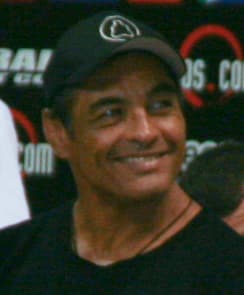
born 1958
Rickson Gracie
He took the family's claim to Japan in the mid-1990s and won there, and he is also the clearest case in the sport of a reputation that grew faster than the record behind it.
Rickson Gracie was born on 20 November 1958, the third of Helio Gracie's sons, and was raised to be the family's fighting representative in the way Carlson had been in the 1950s and Rolls in the 1970s. Sherdog's fight finder records eleven professional wins and no losses, four of them in Japan and the last against Masakatsu Funaki at Colosseum 2000 in May 2000. Of the eleven, nine are submissions.
The consequential part of that record is Japanese. Sherdog's own account of the period describes him as having won two Vale Tudo Japan tournaments by the mid-1990s and being regarded as the best fighter in the world at the time, and his two wins over the professional wrestler Nobuhiko Takada, at Pride 1 in October 1997 and Pride 4 a year later, were the fights the early Pride organisation was built around. Whatever one thinks of the surrounding mythology, the effect was concrete: a Brazilian grappler beating Japan's biggest pro-wrestling draw, twice, on Japanese television, is a large part of why Japan produced a professional MMA industry in the late 1990s and why Brazilian teams then had somewhere to earn a living.
The mythology has to be dealt with directly, because it is now the main thing attached to his name. The figure of four hundred fights without a defeat is repeated constantly. BJJ Heroes calls it a common myth in its own summary of his career, notes that the count is supposed to cover jiu-jitsu, judo, sambo, MMA and closed-door matches together, and states that it can be disputed because at least one loss is on record - a points defeat by throw to Ron Tripp in sport sambo. The publicly documented competitive record is a small fraction of four hundred, and the closed-door matches are, by definition, the part nobody can check.
The best-known of those closed-door fights makes the problem plain. The Japanese fighter Yoji Anjo travelled to California in the mid-1990s with a press entourage to challenge him; Rickson accepted on condition that it happen immediately, privately, and be filmed only by one of his own students. The account of what followed is one-sided, and the footage has never been released. That is not evidence of anything except that a fight happened, and it is a useful illustration of how a reputation of this kind is built: not from falsified results, but from results nobody outside the room was allowed to examine.
Even the well-known stories wobble under a second look. BJJ Heroes places his first fight against Rei Zulu in 1980 and states that he was eighteen at the time; a man born in November 1958 was twenty-one in 1980. The two claims cannot both be right, and the same page gives no source for either. This is the ordinary condition of Brazilian fight records before the 1990s, and the fact that it applies to the most famous of them is the point worth taking away.
None of this argues that he was not formidable. Eleven documented professional wins with no losses, in an era with no weight classes worth the name and a rule set that changed by promotion, is a serious record on its own terms. It simply is not four hundred, and the gap between the two numbers has done more to shape how people talk about jiu-jitsu than any technique he taught.
What changed because of them
He won two Vale Tudo Japan tournaments and twice beat Nobuhiko Takada in the early Pride events, which is the hinge on which Japanese professional MMA - and with it the first stable overseas market for Brazilian grapplers - turned. He is also the sport's standing example of an unverifiable competition record repeated as fact.
Where the record is contested
- The frequently repeated record of 400 wins and no losses is not supported by any record consulted here. BJJ Heroes describes it as a common myth and notes a recorded sambo loss by points to Ron Tripp. Sherdog lists eleven professional MMA wins and no losses; that is the only tabulated record used in this entry.
- BJJ Heroes states that Rickson was eighteen at the time of his first fight with Rei Zulu, which it dates to 1980. His date of birth, per Sherdog, is 20 November 1958. The two statements are incompatible and no source resolves them.
- The closed-door match against Yoji Anjo is described only in accounts sympathetic to one participant, and the footage has never been made public. Nothing about its conduct or result is asserted here.
- BJJ Heroes notes on its own page that the grappling record it displays is a work in progress compiled from magazines, books and video, and is not complete.
Sources
- Rickson Gracie, fighter record and fight historySherdog · consulted 2026-08-04
- Rickson Gracie, fighter profile and biographyBJJ Heroes · consulted 2026-08-04
- "MMA Roots: The Fiasco That Brought Rickson Gracie to Rio in 1995"Sherdog · consulted 2026-08-04
- File:Rickson gracie 20080608.jpg, image licence and provenanceWikimedia Commons · consulted 2026-08-04
Elsewhere in Guard Theory
Journal
- Why sport jiu-jitsu does not transfer directly to MMA
Not a question about who would beat whom. A question about which constraints changed between the two activities, and what each change does to the value of a position.