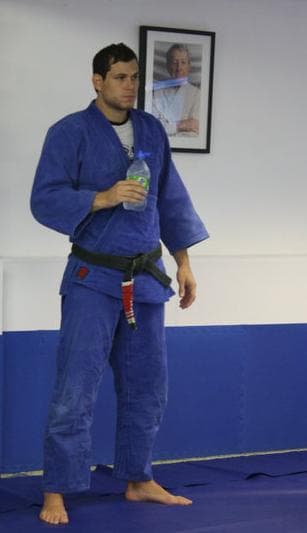
born 1981
Roger Gracie
He won at the highest level of the gi ruleset with the mount and the cross choke, the two things every beginner is taught in the first month, and made the case that the basics were never the problem.
Roger Gracie was born on 26 September 1981, the son of Reila Gracie - Carlos Gracie's daughter - and Mauricio Gomes, one of the handful of men who received a black belt from Rolls Gracie. He won world titles at blue, purple and brown belt, moved to London as a teenager to live with his father, and was awarded his black belt by his uncle Carlos Gracie Junior in 2004. His own site describes him as a ten-time jiu-jitsu world champion. The IBJJF lists him in its Hall of Fame.
The single result that carries the argument is ADCC 2005. He entered the weight class and the absolute division, won both, and submitted all eight of his opponents doing it. BJJ Heroes states that this had not been done before. In a no-gi tournament with a points system built to reward stalling in the first period, submitting every opponent in two brackets in one weekend is about as close as grappling gets to an unambiguous result.
What makes him a figure rather than a champion is what he did it with. His recorded finishes cluster around a very short list: the cross choke from the mount, and chokes from the back. Neither is obscure, neither is athletic in the way a modern leg entanglement is athletic, and both are taught to white belts in their first month because they are considered elementary. Against black-belt opposition that knew precisely what he intended, at world championships and in the absolute divisions where he was often not the largest man, they kept working.
That is a technical argument with an audience, and the audience heard it. The prevailing assumption in competitive jiu-jitsu through the 2000s was that high-level results required a large, specialised and constantly refreshed repertoire. His record is the standing counter-example: a small set of positions, taken to a depth almost nobody else bothered with, beating a much wider set of options taken to ordinary depth. Whether the lesson generalises is arguable. That it was demonstrated is not.
He fought professionally in mixed martial arts as well, submitting Ron Waterman and Yuki Kondo and stopping Kevin Randleman in Strikeforce, and BJJ Heroes notes that he won a world championship in the gi only days after one of those fights with a few weeks of preparation. His MMA career did not reach the same level as his grappling, and no claim is made here that it did.
One caution about the numbers. Titles in this sport are counted differently by different people, because most world championships award both a weight division and an absolute division, and sources vary in whether they count those separately. His own site's figure of ten world titles and BJJ Heroes's reference to a fourteenth world championship are describing the same career with different arithmetic. The specific results are checkable; the total depends on the convention.
What changed because of them
He won ADCC 2005 in both his weight class and the absolute division, submitting all eight opponents, and accumulated world titles in the gi using a repertoire centred on the mount and the cross choke. That record is the clearest available evidence that depth in elementary positions still decides matches at the top of the modern ruleset.
Where the record is contested
- The number of world titles varies by source and by counting convention. Roger Gracie's own site gives ten; BJJ Heroes refers to a fourteenth world championship while listing the years separately and marking absolute-division wins. No single total is asserted here.
- The competition results are taken from BJJ Heroes and from his own site. No accessible official ADCC results archive was reachable on the date of writing. The IBJJF Hall of Fame listing is official and confirms his standing rather than the individual results.
- BJJ Heroes states that submitting all eight opponents to win both ADCC divisions in 2005 had never been done before. That is the source's claim and no independent record of prior editions was available to check it against.
Sources
- Roger Gracie, fighter profile, titles and grappling recordBJJ Heroes · consulted 2026-08-04
- Roger Gracie, official site biographyrogergracie.com · consulted 2026-08-04
- Hall of Fame (Roger Gracie Gomes listed among male inductees)International Brazilian Jiu-Jitsu Federation · consulted 2026-08-04
- File:RogerGracie.JPG, image licence and provenanceWikimedia Commons · consulted 2026-08-04
Elsewhere in Guard Theory
Technique Library
- Seat belt and hooks
Back control is held by the chest connection first and the legs second, and understanding that ordering explains most of what goes wrong when the back is lost.
Journal
- The rear naked strangle from back control
A strangle and a neck crank are separated by a small change in what the second hand is doing, which is why four rule books bothered to write the difference down.