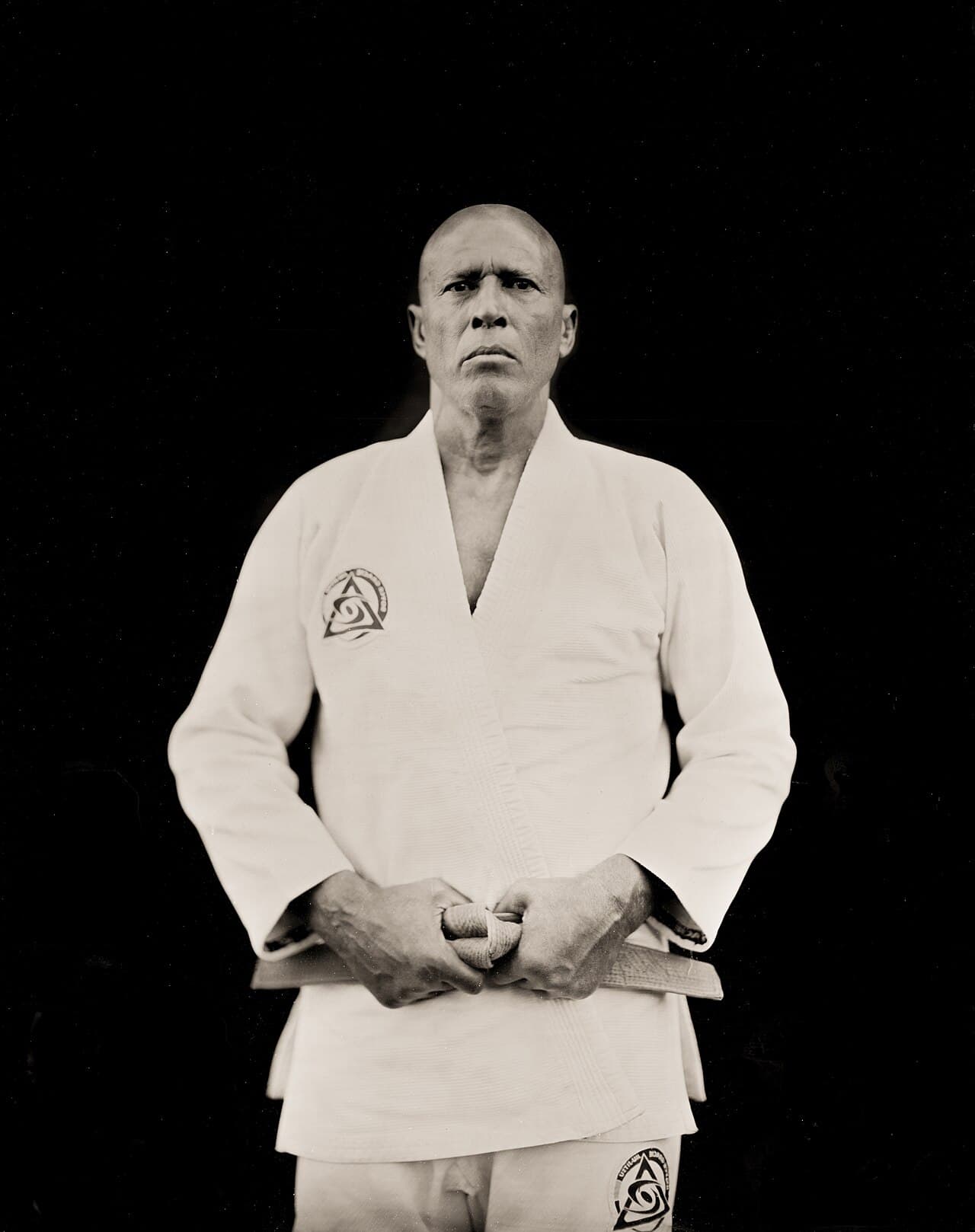
Influential figures born 1966
Royce Gracie
On one night in Denver in 1993 he won three fights in a total of under five minutes of mat time, in front of a paying audience and a camera, and the argument about whether grappling mattered changed for good.
Royce Gracie was born on 12 December 1966, one of Helio Gracie's sons, and by his own family's account was not the best fighter in it. His brother Rickson was. The choice of Royce to represent the family at the first Ultimate Fighting Championship was a decision about what the family wanted to demonstrate: send the lightest, least imposing man available, so that nothing about the result could be attributed to size.
Sherdog's record of the night is worth reading as a document rather than a highlight reel. At UFC 1 in Denver on 12 November 1993 he beat the boxer Art Jimmerson by smother choke in 2:18, Ken Shamrock by lapel choke in 0:57, and the savate fighter Gerard Gordeau by rear naked choke in 1:44. Two of the three were refereed by Helio Vigio, an old associate of the family from Rio. Four months later at UFC 2 he won four fights in one night, three of them in under a hundred seconds each. At UFC 4, in December 1994, he won the tournament again. The UFC's own site lists his career at 13-2-2 and carries him in its Hall of Fame.
What made this consequential was not novelty - grapplers had been beating strikers in Brazilian vale tudo for decades - but format and audience. The results were dated, filmed, sold to a paying public and repeated on a schedule. Anyone teaching a striking art in 1994 now had to answer a specific question about a specific tape, and the honest answers pushed training rooms towards grappling within a few years.
The record also contains its corrections, and they belong here. At UFC 3 in September 1994 he submitted Kimo Leopoldo and then withdrew, exhausted, before his semi-final. In December 1998 he accepted a jiu-jitsu challenge from Wallid Ismail, a Carlson Gracie black belt who had been calling him out for years, and was finished with a clock choke. His later career, in Pride, in K-1 and in a 2006 return to the UFC against Matt Hughes, was that of a specialist who had been caught up with: Sherdog records the Hughes fight as a technical knockout loss. After a decision win over Kazushi Sakuraba in Los Angeles on 2 June 2007, the California State Athletic Commission reported that he had tested positive for the anabolic steroid nandrolone, suspended him until 30 May 2008 and fined him $2,500, as Sherdog and ESPN reported at the time. He denied it, saying he had never taken anything other than natural supplements and proteins.
The wider point is about what the early tournaments actually proved. They demonstrated that an unprepared striker has no answer to a competent grappler, which was worth knowing and was not widely believed. They did not demonstrate that jiu-jitsu beats everything, and the sport spent the following decade discovering the difference as wrestlers, and then strikers who had learned to defend takedowns, closed the gap. Royce Gracie's contribution is the demonstration, not the conclusion that was drawn from it.
Correction, 29 September 2026: an earlier version of this entry said that at UFC 3 he withdrew before the final; Sherdog lists his win over Kimo Leopoldo as his only bout that night, and he withdrew before the semi-final. It also left out his 2007 positive test for nandrolone on the grounds that no established news report could be found. Sherdog and ESPN both reported it in June 2007, and it is now stated with his denial. Claims that grapplers had beaten strikers in vale tudo for sixty years, that the early UFCs reorganised training rooms worldwide within five years, and that he was choked unconscious by Wallid Ismail went beyond the sources and have been narrowed.
What changed because of them
He won the first, second and fourth UFC tournaments in 1993 and 1994, on video and on a published schedule, which converted a claim about grappling into evidence that striking-only schools had to answer. The reorganisation of martial arts training that followed is traceable to those specific dated events.
Where the record is contested
- Career totals differ by source and by what is counted. The UFC's own athlete page gives 13-2-2; Sherdog's fight finder lists fifteen wins, including bouts outside the UFC and a 2016 Bellator match. Neither is wrong; they are counting different things.
- The 2007 positive test is taken from contemporary reports by Sherdog and ESPN, which give the substance, the suspension dates and the fine, and from BJJ Heroes, which notes that he disputed the commission's finding. ESPN quotes his denial. The commission's own record was not retrieved.
- The account of why Royce rather than Rickson was chosen to represent the family at UFC 1 is family testimony repeated in secondary sources. It is plausible and it is not documented.
Sources
Each source opens in a new tab.
- Royce Gracie, athlete profile and career record (opens in a new tab)Ultimate Fighting Championship · consulted 2026-08-04
- UFC 1: The Beginning, event page (opens in a new tab)Ultimate Fighting Championship · consulted 2026-08-04
- Royce Gracie, fighter record and fight history (opens in a new tab)Sherdog · consulted 2026-09-29
- Royce Gracie, fighter profile and biography (opens in a new tab)BJJ Heroes · consulted 2026-09-29
- Josh Gross, "Gracie Fails Drug Test, Suspended", 14 June 2007 (opens in a new tab)Sherdog · consulted 2026-09-29
- "Gracie suspended after testing positive for Nandrolone", 15 June 2007 (opens in a new tab)ESPN.com news services · consulted 2026-09-29
- File:Royce Gracie Brazilian Jiu-Jitsu Wet Plate Collodion by Shane Balkowitsch.jpg, image licence and provenance (opens in a new tab)Wikimedia Commons · consulted 2026-08-04
Elsewhere in Guard Theory
Journal
- What the early UFC tournaments actually demonstrated
The events are cited as proof that grappling beats striking. Read the format the way you would read any other experiment and the claim they support is much narrower, and more durable, than the one they are used for.